
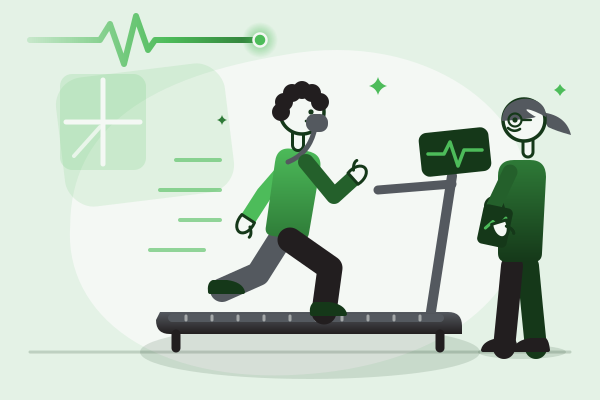
Why test?
Intensity and lactate build-up are among the most important factors in training. Knowing how your body responds to different intensities gives you a better basis for training efficiently.
- Understand your own body better
- Define your training zones
- Plan your training using the Olympiatoppen intensity zones
Lactate test
A lactate profile shows how your lactate level changes with intensity. On a bike, lactate is measured against heart rate and watts; on a treadmill, against heart rate and speed.
- Duration: 1 hour
- Test on a bike or treadmill
- Lactate profile, plus power profile when testing on a bike
- Defined training zones
- Report with results and training zones
- Guidance straight after the test
VO2 max test
A VO2 max test measures your maximal oxygen uptake.
- Duration: 1 hour
- Test on a bike or treadmill
- VO2 max test
- Defined training zones
- Report with results and training zones
Preparing for your test
To make your results as accurate and comparable as possible, arrive rested and prepared. This applies both to your first test and to later tests where you follow your progress.
Training in the last few days
- Do not train on the day of the test before the test.
- Train only lightly the day before.
- Avoid hard sessions and long, moderately hard sessions in the last 2–3 days before the test.
- If possible, schedule the test in a week with a light training load.
Food and drink
- Eat as usual in the last few days, preferably with plenty of carbohydrates the day before.
- Eat your last larger meal 2–3 hours before the test.
- Drink well the day before and on the day of the test. Drink only water in the last hour before the test.
- Do not take more caffeine than usual, and avoid caffeine in the last 4 hours before the test.
- Avoid energy drinks, pre-workout and similar supplements before the test.
- Do not drink alcohol in the 24 hours before the test.
- Consider bringing a carbohydrate snack for after the test.
Sleep and daily life
- Get enough sleep the night before the test.
- Keep the days before the test as normal as possible, with your usual workload.
Illness, injury and medication
- Do not take the test if you are ill, have a cold or are injured. Contact us and we will find a new time.
- If you take medication or have a condition that may affect the test, let us know before the test.
- Take your medication as usual unless your doctor has told you otherwise.
What to bring
- Training clothes and a change of clothes, as you will sweat
- Running shoes for a treadmill test
- Bike: You can use our test bike or bring your own. Many prefer their own bike.
- If you use our test bike, bring your own cycling shoes and pedals.
- Towel
- Water bottle
- Your own heart rate strap if you like (optional)
When you arrive
- Arrive 10 minutes before your appointment, preferably changed and ready.
- The warm-up is part of the appointment, so there is no need to warm up beforehand.
Retests – keep conditions the same
- Test at the same time of day as last time.
- Use the same shoes and clothes, and the same bike and pedals if relevant.
- Follow the same routine for training, food, drink and sleep in the last few days.
- Write down what you ate and drank, and when, so you can repeat it next time.
- Choose the same test mode (treadmill or bike) and the same tests as last time.
Who runs the test?
Tests are run by physiologist Sylvi Sommer, who holds a master’s degree in sports medicine from the Norwegian School of Sport Sciences.
Prices
- Lactate test or VO2 max testNOK 1,350
- VO2 max and lactate testNOK 2,100 (90 minutes)
- Applies to tests on a treadmill or bike
FAQ
Can I test on a treadmill or a bike?
Yes, you choose whether the test is done on a treadmill or a bike.
Can I do both tests on the same day?
Yes, you can book a VO2 max test and a lactate test together for NOK 2,100.
How long does the test take?
A lactate test takes 1 hour, and a VO2 max test takes 1 hour. Both tests together take 90 minutes.
How do I prepare for the test?
Arrive rested: do not train on the day of the test, train only lightly the day before, and eat your last larger meal 2–3 hours before the test. The full list is under Preparing for your test.
Can I take the test if I am ill?
No. If you are ill, have a cold or are injured, you should not take the test. Contact us and we will find a new time.